


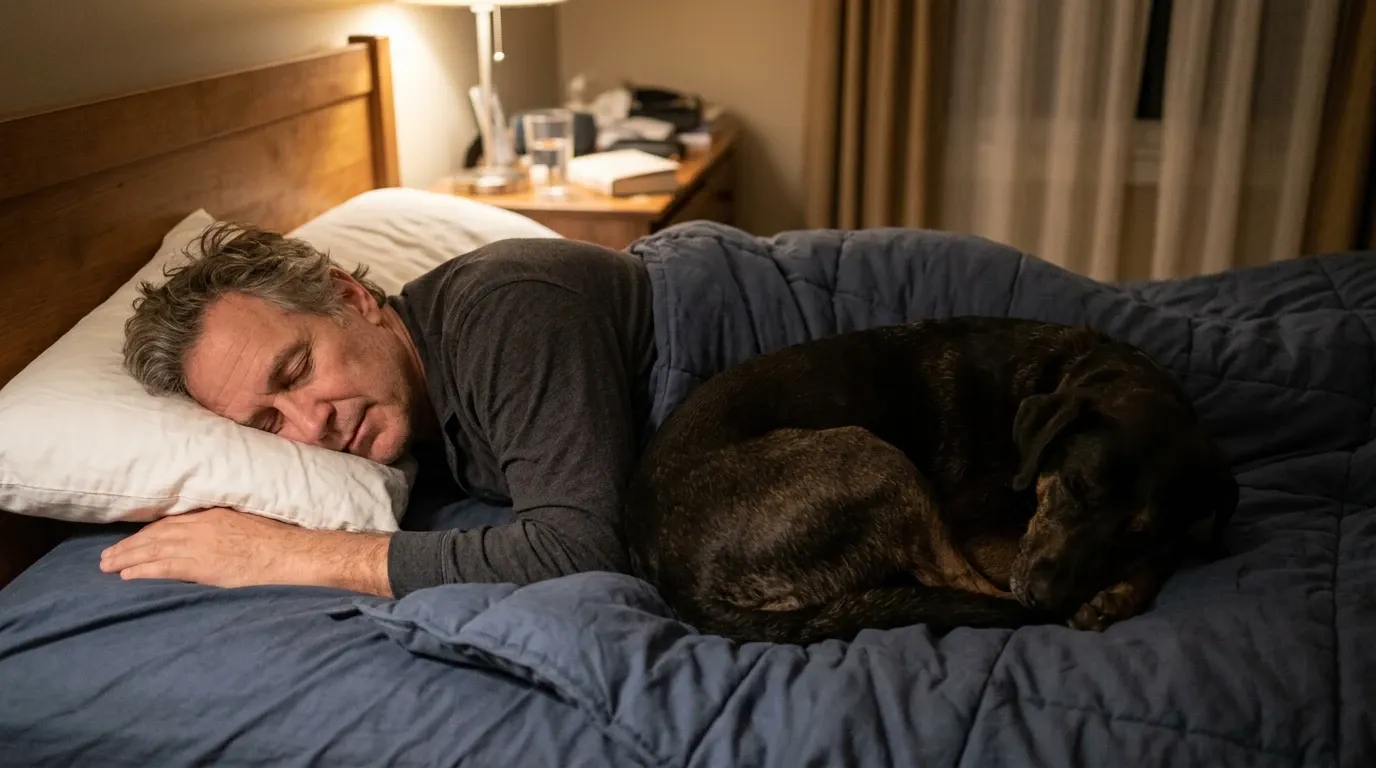
You went to bed with 75% of the mattress. You woke up clinging to a sliver of fitted sheet, neck at a 40-degree angle, feet dangling off the edge, a very comfortable dog sprawled across the center like royalty.
You didn’t move him.
You never do.
If that sounds familiar, you’re in good company. Dogs sleeping in their owner’s bed is one of the most universal, ridiculous, and sweet things that happens in homes every night. Blame biology, love, and a 40-lb animal with no concept of personal space.
The Horizontal Roadblock Is Real (And Completely Your Dog’s Fault)
Dog owners have a name for it: the horizontal roadblock. Your dog starts the night curled neatly at your feet. Sometime around 2 a.m., the slow migration begins. By morning, they’re diagonal, back pressed into your ribs, occupying a mathematical impossibility of surface area for their size.
Dogs position themselves where they feel most secure, pressed against you for warmth and contact. A Canisius University study tracked preferred sleep positions using heat maps and found dogs gravitate toward their owner’s legs, midsection, or chest. The bigger the dog, the bolder the claim.
Your dog is being a dog, doing what feels right. Your back disagrees. The trust is real. The diagonal sprawl is one of many sleep positions that signal something deeper. If you’ve ever seen your dog roll onto their back with all four paws in the air, that one is actually the ultimate compliment to you.

You’re Not Alone — The Numbers Are Embarrassing
The numbers on dog co-sleeping are staggering.
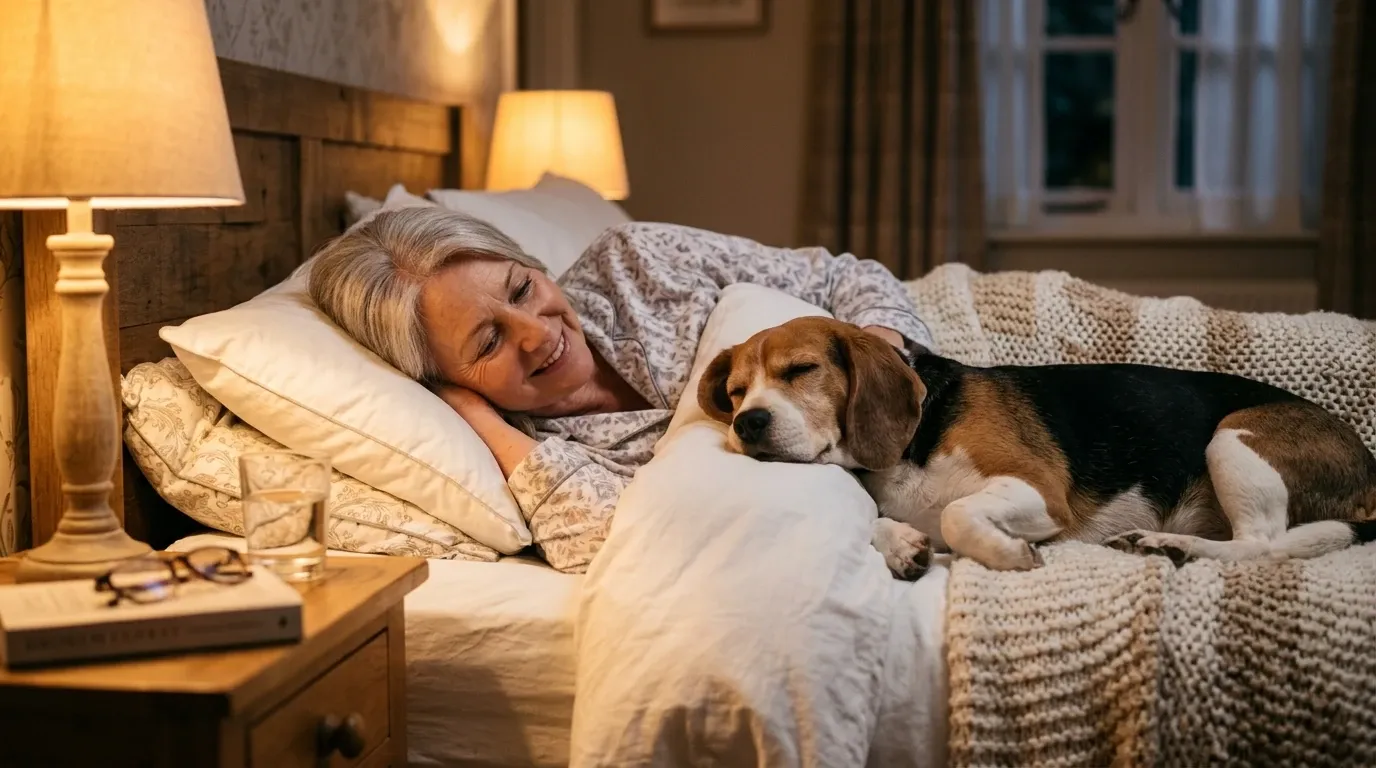
A 2022 survey from the American Academy of Sleep Medicine found 46% of Americans sleep with a pet. A separate Sniffspot survey puts that number among dog owners at 82%. Most telling: 33% of married dog owners say their best night’s sleep happens with only the dog in the bed.
Single owners co-sleep at even higher rates, 80%, compared to 73% of partnered owners. Among co-sleeping owners, the reasons are consistent: 67% say it reduces stress, 60% say it eases anxiety, and 59% say it makes them feel less lonely at night.
This is the norm.
Why We Let It Happen (And Keep Letting It Happen)
You can’t bring yourself to move your dog, even when your shoulder goes numb, because your brain is working against you.
Sleeping close to your dog triggers oxytocin release. Skin contact, steady breathing, the familiar weight of them: your cortisol drops, your heart rate slows, your body reads safe. Dr. Andrea Matsumura of the American Academy of Sleep Medicine puts it plainly: “Many pet owners take comfort in having pets nearby and sleep better with their companion by their sides.”
The bond you’ve built with your dog doesn’t switch off at bedtime. Those nighttime hours reinforce it. Mammals evolved sleeping in contact, and your dog fits that system precisely. Psychology Today notes that this pull toward closeness runs through our evolved attachment systems. Your dog leaning their full body weight against your legs in the kitchen runs on the same wiring.
What Your Dog Is Actually Getting Out of This
Your dog is winning this one, and the data backs it up.
A recent study published in PMC/NIH used EEG monitoring to track dogs’ sleep with and without their owners. Dogs sleeping alongside their owners showed higher sleep efficiency (up to 85%) and shorter time to fall asleep. They also spent more time in restorative non-REM sleep.
Your dog is thriving in that bed.
For pack animals, sleeping beside a trusted companion is where instinct points. Snoring away beside you, they may be dreaming about you, replaying the day’s walks and moments with their favorite person.
Making Peace With the Mattress Situation
You have options, and none require guilt.
If you want to share the bed: A designated dog blanket at the foot and a consistent bedtime routine help most. Once a dog has a clear spot, the horizontal roadblock settles into something predictable.
If you’d like to reclaim some space: A dog bed placed right beside yours is the gentlest transition. Your dog keeps your scent, your presence, your proximity. You might stretch your legs.
If you’ve decided this is just your life now: The research supports it, the bond is real, and that warm weight against your feet is one of the better things about owning a dog. If you’ve already rearranged your schedule around walk time and stopped eating dinner without sharing a bite, you might as well own that identity fully. You’re in good company.
You’re sleeping with someone you love.